
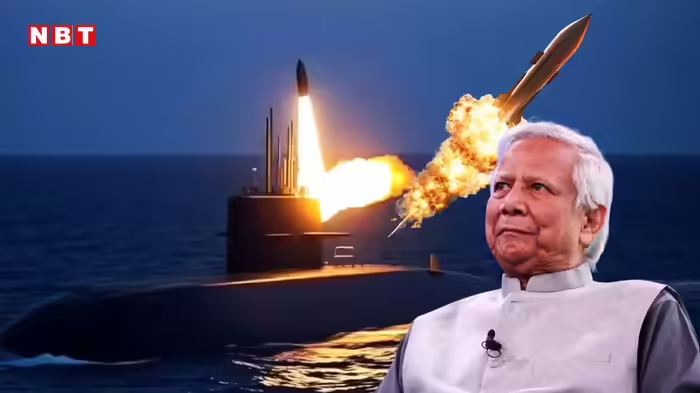
At a time when Bangladesh is grappling with severe internal unrest and rising concerns over the safety of minority communities, India has delivered a powerful strategic message by successfully testing its K‑4 submarine-launched ballistic missile in the Bay of Bengal. The test, conducted quietly but decisively, underscores India’s growing maritime nuclear capability and its resolve to safeguard regional stability and national security.
The K‑4 ballistic missile, with a strike range of approximately 3,500 kilometers, was launched from India’s nuclear-powered submarine INS Arighat, marking a major milestone in the country’s sea-based nuclear deterrence. Although the Ministry of Defence has not issued an official statement, defence sources confirmed that the test met all operational and technical objectives.
Why the K‑4 Missile Test Matters
The timing and location of the test are being viewed as highly significant. Conducted in the Bay of Bengal—geographically close to Bangladesh—the launch sends a clear strategic signal without direct military escalation. The solid-fuel K‑4 missile is capable of carrying a two-ton nuclear payload, substantially enhancing India’s second-strike capability.
Defence experts say the test reinforces India’s nuclear triad—land, air, and sea-based deterrence—making the country’s defence posture more credible and resilient.
Launch from INS Arighat
INS Arighat, a 6,000-ton nuclear-powered ballistic missile submarine, is operated under the Strategic Forces Command. The submarine was inducted into the Indian Navy on 29 August 2023 and represents a major leap in India’s indigenous naval nuclear programme.
Sources revealed that the missile’s performance data will now undergo detailed technical and mission analysis. This follows earlier trials, including the first successful K‑4 test from INS Arighat in November 2023.
Strengthening India’s Nuclear Submarine Fleet
INS Arighat is India’s second operational nuclear-powered ballistic missile submarine, following INS Arihant, which became fully operational in 2018 but was limited to shorter-range K‑15 missiles. With the induction of K‑4 missiles, India is now preparing for longer-range systems such as K‑5 and K‑6, expected to have ranges between 5,000 and 6,000 kilometers.
India plans to commission its third nuclear submarine, INS Aridhaman, in early 2026, followed by a fourth by 2027–28. These developments are part of a long-running, classified ₹90,000‑crore Advanced Technology Vessel (ATV) programme. Future submarines will be larger, more powerful, and equipped with 190 MW nuclear reactors, significantly enhancing endurance and strike capability.
A Clear Message to Regional and Global Powers
The successful K‑4 missile test is not just a technological achievement—it is a strategic statement. Submarine-launched ballistic missiles are among the most difficult to detect, making them a critical element of deterrence. In the event of a conflict, such platforms can deliver a decisive response while remaining virtually invisible.
Analysts believe the test also positions India closer to the strategic capabilities of major nuclear powers such as the United States, Russia, and China, which possess intercontinental ballistic missile systems.
Implications for Bangladesh and Beyond
Against the backdrop of political instability and mass protests in Bangladesh, the test has inevitably drawn attention in Dhaka, as well as in Islamabad. Without naming any country, India has once again demonstrated that it will not compromise on strengthening its defence preparedness.
The K‑4 missile test serves as a diplomatic yet firm reminder: India remains vigilant, strategically capable, and fully prepared to protect its national interests amid an increasingly volatile regional environment.
Related
Discover more from SD NEWS agency
Subscribe to get the latest posts sent to your email.
Discover more from Metro Mirror
Subscribe to get the latest posts sent to your email.